


Programarea sistematică în limbajele PASCAL și FORTRAN
[Systematic Programming in the PASCAL and FORTRAN Languages] — Editura Tehnică, 1984
Authors: Luca-Dan Șerbănați • Valentin Cristea • Florica Moldoveanu • Valeriu Iorga
Editorial details
- Publisher: Editura Tehnică, 1984
- Authors: L.D. Șerbănați, V. Cristea, F. Moldoveanu, V. Iorga
- Pages: 403
- Key topics: structured programming, program design, PASCAL, FORTRAN, debugging
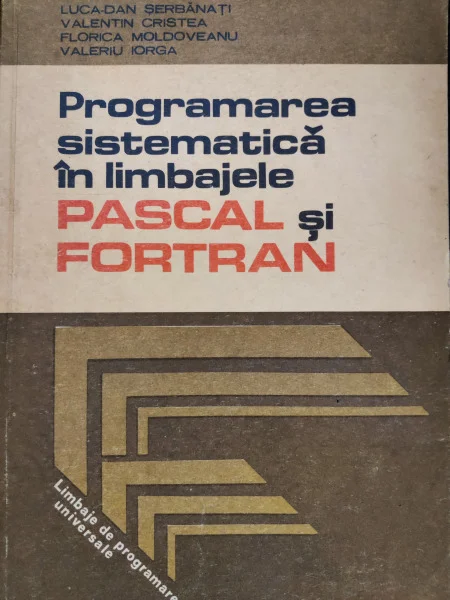
Front cover of the volume.
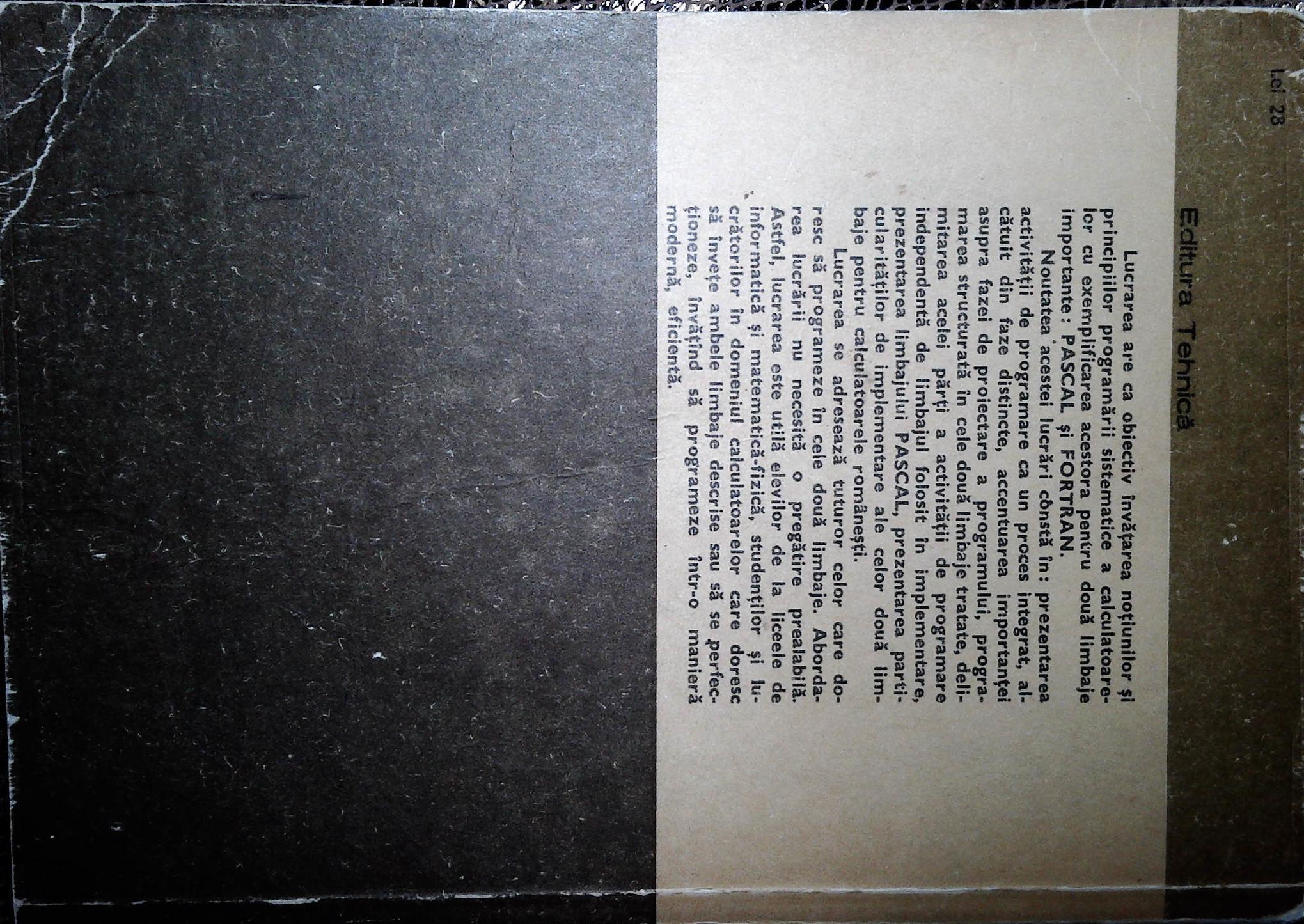
Back cover of the volume.
Summary
The textbook introduces structured programming and program design through step-by-step refinement, with examples and projects in PASCAL and FORTRAN. The preface argues for the transition from the craft of coding to an engineering of programming, insisting on program quality, the life cycle, and maintenance costs. The observations on the criteria of a correct program and on the weight of testing and maintenance are presented in the preface written by Academician Mihai Drăgănescu.
Contents
Table of contents of the book
General structure of the book
I am the author of the first three parts of the book.
- 1. Introduction
- 2. Program design
- 3. Programming in PASCAL — data types, declarations, statements, subprograms, files
- 4. Programming in FORTRAN — data types, expressions, input/output, FORMAT, control, subprograms
- 5. Debugging programs and complex examples
- Appendices: particularities of PASCAL / FORTRAN on Romanian computers; the RAFFOR language; FORTRAN 77
Complete table of contents
Download the table of contents (PDF)Preface
The preface written by Academician Mihai Drăgănescu explains the transition toward design disciplines in program development, defines levels of correctness for programs, and illustrates the distribution of costs throughout the life cycle of a software project.
The preface of the volumeThe place of the book in the evolution of programming education
This book was written in a transitional period, in the early 1980s, when programming instruction at the Polytechnic was moving away from FORTRAN, the dominant language of the 1970s, and turning toward PASCAL. I had already imposed this change in the late 1970s in the Computers specialization of the Automation Faculty, where, in the fourth year, I introduced the teaching of PASCAL, as can also be seen from the textbook Limbaje și compilatoare, Part II (1982).
Later, the transition to PASCAL was extended to the introductory first-year course Programarea calculatoarelor at the Automation Faculty, while I myself moved, in the fourth year, to teaching the C language. In this sense, the book records a first transition: the extension, across the whole Polytechnic, of the move from FORTRAN to PASCAL.
For those who had already learned FORTRAN, the volume also offered the possibility of a direct comparison with PASCAL. The part devoted to PASCAL was written by me, while the other parts were written by my colleagues.