


Health digital state and Smart EHR systems
Article (2020) on defining a digital equivalent of the health concept (Health Digital State — HDS) and the Smart EHR infrastructure (with the Virtual Health Record — VHR core), designed for clinical data integration, computable summaries, and decision support.
Navigation
Bibliographic data
Author: Luca Dan Șerbănați
Journal: Informatics in Medicine Unlocked, vol. 21, 2020, article 100494
Keywords: HDS, Smart EHR, VHR, interoperability, DIHS, decision support, digital ecosystems
Citation (short):
Șerbănați, L. D., “Health digital state and Smart EHR systems”, Informatics in Medicine Unlocked, 21 (2020), 100494.
Figures (click to enlarge)


Contribution
The central novelty is the definition of a digital twin of health (HDS/CHDS), as an operational abstract entity, linked to clinical synthesis (IHS→DIHS) and supported by an active core (VHR) in a Smart EHR architecture.
Details (click to expand)
- Digital twin of health: HDS/CHDS as an object of health, not of the person; at most a facet of it.
- Controlled cognitive transfer: DIHS as a validated, retrievable, and comparable synthesis between episodes.
- Active VHR: integration, contextual selection, reconciliation, and alerting oriented on "state".
- Semantics + coherence: semantic relations and explainable operations before opaque "AI".
- HDS algorithm: semantic mapping + "quarantine" for unmappable items, with conflict handling.
Large Description (section by section)
0. Context, stake and the idea of "digital equivalent"
In 2020 I felt the need to formulate, as clearly as possible, a difference that in the practice of healthcare digitization often remained implicit: it is one thing to computerize documents and workflows, and another to build digital objects that can effectively support the clinical act. The article starts from this tension. I assumed that, in a mature digital ecosystem, it is no longer sufficient for information to be stored; it must be able to be organized, interpreted, and reused coherently, in different clinical contexts.
The central problem I tried to address is conceptual: "health" is indispensable in medical discourse, but it does not easily reduce to a quantity or a stable set of indicators. In practice, health is deduced from facts, contexts, histories, and interpretations. Therefore, if we want systems that support decision-making in the healthcare system, we must first define a digital equivalent of the health concept: a representation rich enough to be used, but disciplined enough to be computed, updated, verified, and interpreted.
In this article I introduced this representation under the name Health Digital State (HDS). I did not aim for a "final" definition of health, but an operational digital construction, derived from data and clinical validations, which can function as an integration point between data (EHR), interpretations (clinical summaries), and actions (treatment plans).
To make this idea implementable, I introduced the Smart EHR digital infrastructure (with the Virtual Health Record — VHR core, an old idea of mine), viewed as a distributed integration platform capable of collecting heterogeneous data, transforming them semantically, and supporting "health state" objects (DIHS/HDS) in a reusable way.
After 2020: In the following years it became more visible that the mere accumulation of data (from clinical systems, devices, apps, monitoring) does not automatically produce a coherent clinical picture. The pressure for "active summaries", reconciliation, inconsistency detection, and decision support has practically reinforced the need for a health state representation, not just documents.
1. Introduction: digital transformation and the limits of document-centric EHR
The introduction starts from the idea that digital transformation is not a simple "electronization" and/or "computerization" of existing processes, but a mutation in which persistent digital entities appear in a specialized digital ecosystem, capable of mediating and sometimes influencing real-world activities. In healthcare, this mediation becomes critical because clinical decisions are inevitably dependent on data and its interpretation in a context.
I recalled here the role of the EHR as a longitudinal, potentially inter-organizational record, and emphasized that, in practice, many implementations remain document-centric: information is accessible, but fragmented into static documents, produced in different contexts. The physician is forced to manually "reconstruct" the relevant history, compare versions, observe trends, detect contradictions, and deduce a current, coherent health state.
This work is not only time-consuming; it introduces risk: in the absence of a coherent synthesis, critical information (allergies, drug interactions, relevant results, recent changes) can be missed or misinterpreted. Therefore, I considered that the natural evolution is towards an EHR that not only stores, but also organizes and supports the act of interpretation, within clinically acceptable limits.
I also insisted on the tension between structured and unstructured data. An important part of clinical knowledge remains in free text (letters, notes, conclusions). If we want the EHR to become "smart", it must have a way to transform at least part of these texts into usable concepts: either by coding at the source, or by extraction and normalization. The article does not reduce this problem to a single technique, but treats it as a condition for operating a semantically rich VHR.
After 2020: The massive growth of clinical documents and messages, along with the integration of data from external sources, has accentuated the limits of document archiving. In many contexts it has become obvious that the clinician's time is consumed not by accessing information, but by building a synthesis. It is precisely here that a "health state" representation (CHDS/HDS) becomes useful.
2. Objectives: HDS and Smart EHR as infrastructure
In the objectives section I explicitly formulated two complementary targets. The first was defining the Health Digital State (HDS) as a digital entity that can represent, in an integrated form, a person's health status for a period and/or a context. The second was describing the Smart EHR (with the VHR core) as an infrastructure capable of building and using this state in real clinical processes.
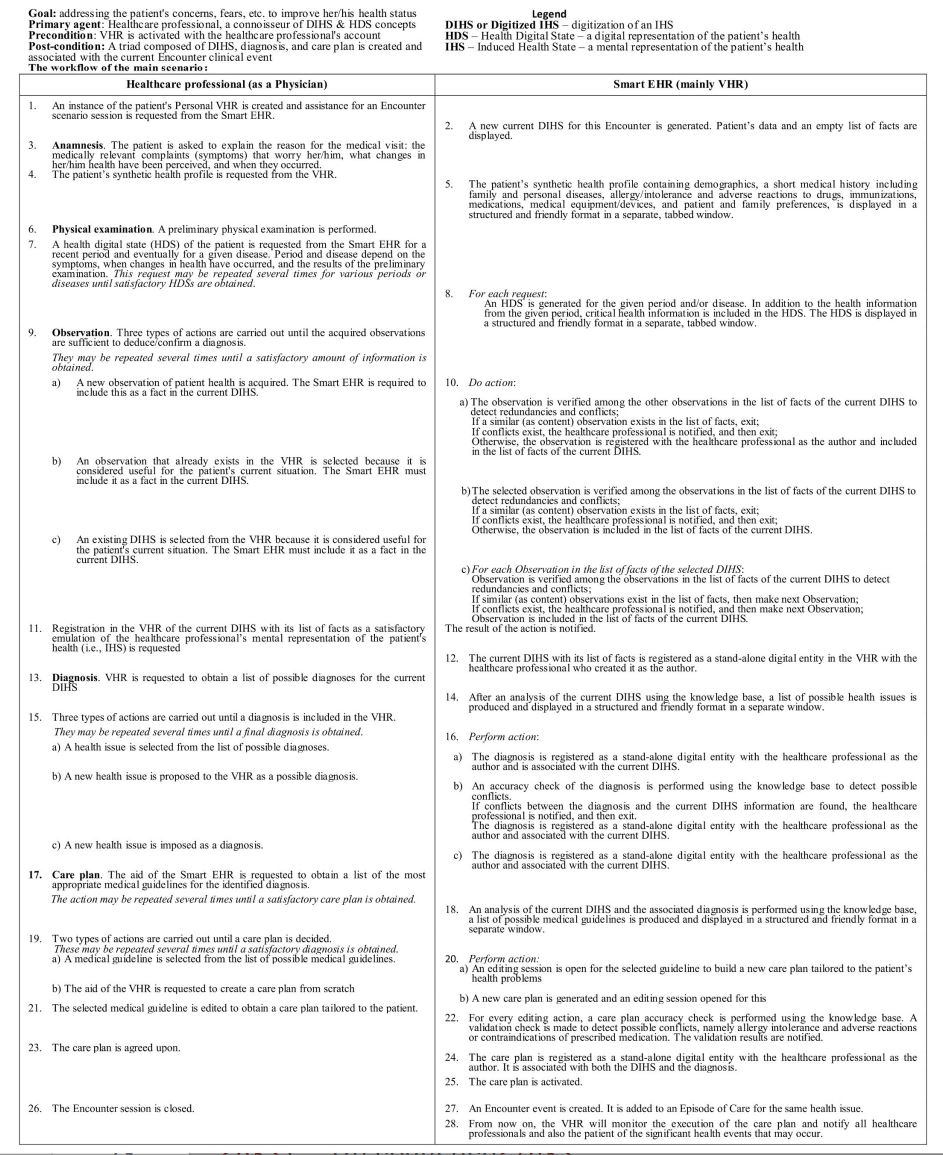
I used the "encounter" scenario as a reference: the moment when the patient and the medical professional meet for a new health problem of the patient, for monitoring or for reevaluating a known problem. In the traditional version, the clinician collects observations, searches for relevant history, makes correlations, then decides. In the proposed version, the Smart EHR/VHR can contextually provide a list of relevant facts (problems, allergies, interactions, recent trends, significant results) and can help build a synthesis that is validatable by the clinician.
An important element of the objectives is that I clearly separated the roles: the system does not substitute professional decision-making, but assumes the IT workload necessary for coherence: integrating sources, deduplicating, signaling conflicts, semantic organization, contextual selection, and navigation support. On this basis, the clinician can edit, if necessary, and then validate the synthesis provided by the system (DIHS) and use it later as a reference for continuity of care.
I also formulated the idea of proactivity: a Smart EHR must be able to trigger notifications and recommendations based on events and usage profiles, while respecting consent and clinical responsibilities. Proactivity is not a cosmetic "bonus"; it becomes necessary when the data volume and the speed of changes exceed the capacity for manual tracking.
After 2020: The focus on monitoring workflows (including remote) and on prevention has made proactivity and contextual selection requirements easier to justify. As data became more continuous and distributed, the need for mechanisms to transform signals into "state" and "alert" in a controlled and auditable way increased.
3. Smart EHR and VHR: from record to active infrastructure
In this section I described what I called Smart EHR: not a "prettier" or more feature-rich EHR, but an infrastructure capable of integrating heterogeneous data sources, transforming them semantically, and coherently supporting digital objects like DIHS and HDS. I deliberately used the term "smart" in a restricted sense: a system that can organize information around a clinical context and provide concrete support (coherence, selection, verification), without substituting professional decision-making.
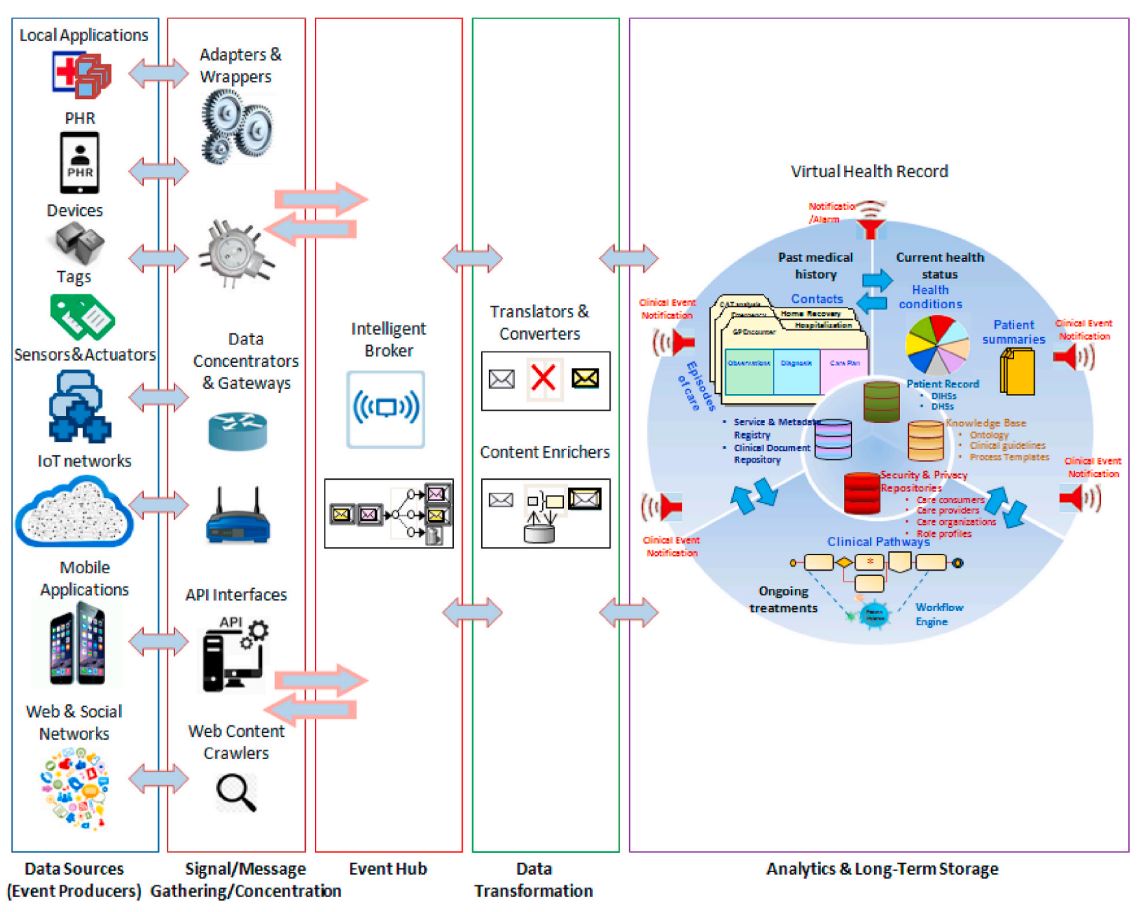
A starting point was the realization that, with the expansion of sources (local systems, personal apps, devices, monitoring), a mechanism for concentrating and normalizing events becomes inevitable. That's why I described the Smart EHR as a distributed platform, where data is collected through adapters and gateways, consolidated in an event node, then passed through conversion and semantic enrichment, before reaching the repositories and the VHR workspace.
In Fig. 2 (global architecture) I synthesized this idea: multiple sources produce signals and documents; these are collected and integrated; transformation follows (conversion, normalization, content enrichment), and then the information is used in an active, patient-centered core, where building a coherent state representation becomes possible. I aimed for a simple thing here: to make it clear that "intelligence" does not come from a single module, but from a sequence of steps for integrating and disciplining information.
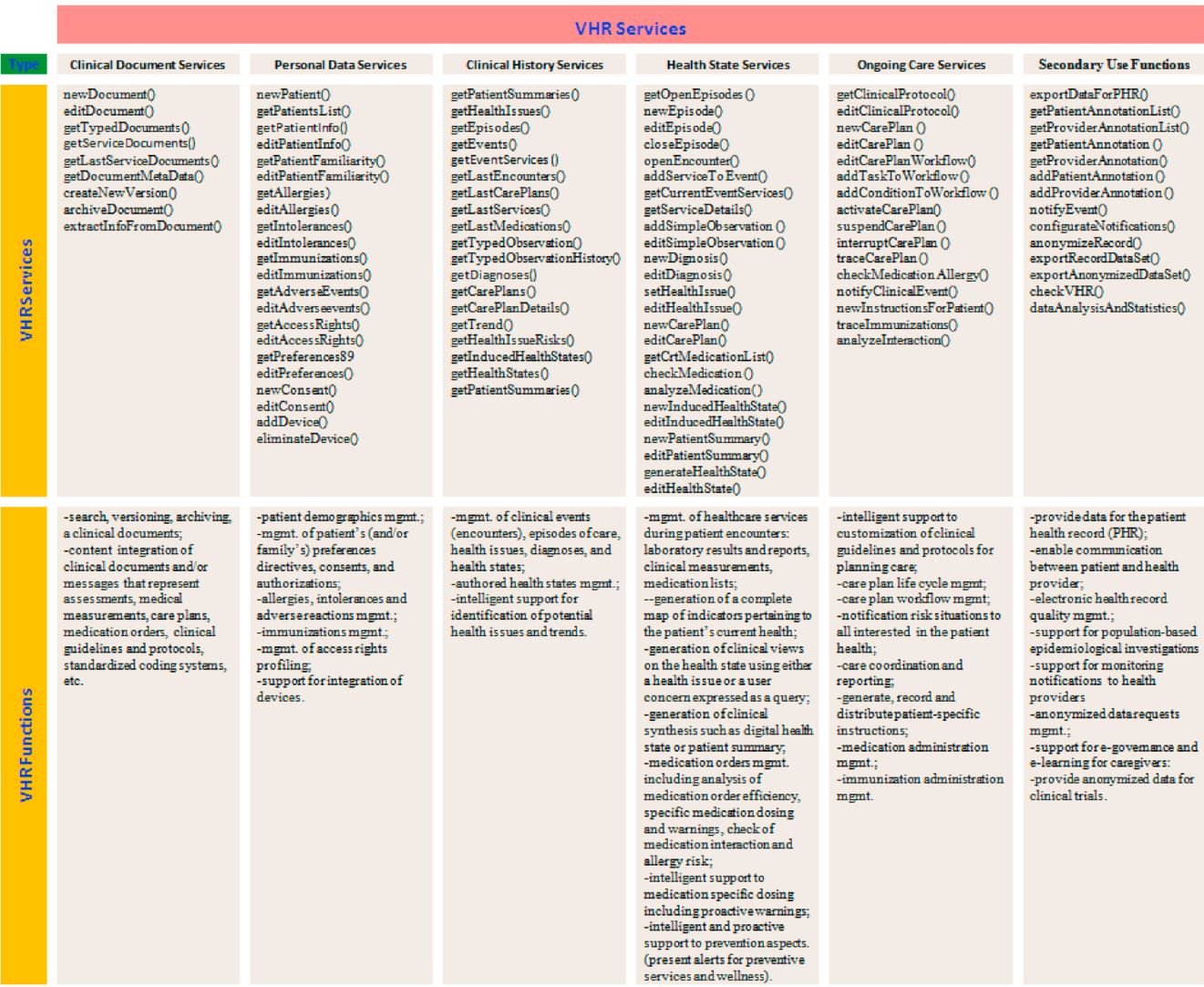
The core of this infrastructure I called Virtual Health Record (VHR). I introduced VHR as a persistent, individual-centered workspace, where information is organized so that it can be used contextually, on episodes, problems, plans, and evolutions. VHR is not just a "copy" of the record, but a representation that can contain: (i) validated summaries (DIHS), (ii) integrated digital states (HDS/CHDS), (iii) semantic links between concepts, (iv) references to guidelines and policies, and (v) notification and support mechanisms.
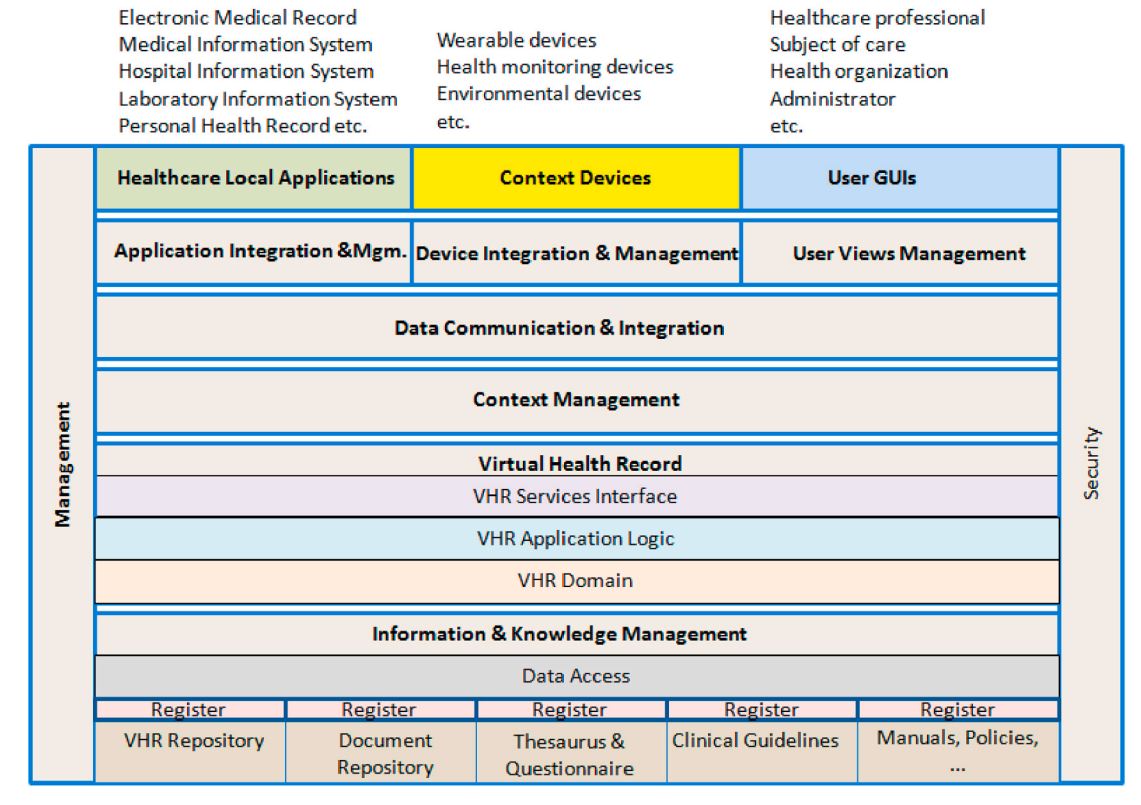
In Fig. 3 (software architecture) I detailed how such a system can be organized in layers: integration of clinical apps and devices, interface management (different views for different actors), context management, then the actual VHR layer (services, logic, domain model), supported by information and knowledge management components. I also insisted that security and governance cannot be treated as "a module" added at the end; they must be transversal constraints, because the VHR aggregates sensitive information from multiple sources and makes it reusable in different contexts.
An aspect I treated explicitly is the relationship between data and concepts: if we want to achieve clinical coherence, raw data must be connected to a vocabulary (thesaurus, questionnaires, codes, ontologies), and observations must gain metadata and relationships that allow selection and verification. That's why, in a Smart EHR, semantic conversion and enrichment are operational requirements, not cosmetic options.
After 2020: In the following years, the proliferation of extra-hospital data (monitoring, apps, devices) made the need for an integration infrastructure that produces coherence even more obvious. It became harder to sustain the idea that the EHR can remain just a document repository, without a "workspace" that contextually assembles information and reduces the burden of manual synthesis. In this sense, the role of a VHR as an active core became easier to explain and less "speculative" than it seemed in 2020.
4. IHS, DIHS, and HDS: how I tried to make "health state" digitally operable
In this section I introduced the most conceptual part of the article: the difference between the health state as perceived and constructed in the clinical act, and the health state as it can be digitally represented, in a form usable for integration and support. I started from a simple observation: the clinician does not work with "raw data", but with a decision-oriented synthesis, built from observations, histories, contexts, and experience. I considered it important to name and delimit this synthesis, in order to discuss it without ambiguities.
I named this synthesis IHS (Induced Health State): the health state "induced" in the mind of the medical professional during an encounter. IHS is not a list of results, but a coherent set of elements considered relevant: which signs carry weight, what information can be ignored, what contradicts itself, what needs to be confirmed, and what leads to a diagnostic hypothesis or a treatment decision. In medical practice, this construction inevitably exists; the difference is that, most of the time, it remains implicit and is lost as a structure, being dispersed in notes and documents.
The next step was to discuss DIHS (Digitized Induced Health State), that is, the digital objectification of this synthesis. I proposed DIHS as an artifact linked to the encounter: a structured representation, validated by the clinician, which preserves not only "what was measured", but also what was considered relevant at that moment and how elements relate to each other. I pursued a pragmatic goal here: if DIHS exists as a digital object, it can be reused in continuity of care, compared between episodes, audited, and can support a more precise discussion between professionals.
DIHS, as I conceived it, does not aim to replace the clinician's reasoning, but to make it retrievable and operable in the digital infrastructure. In a Smart EHR, this allows two things: (1) contextual selection of information (so I don't have to leaf through the entire record to reconstruct the "state"), and (2) assisted verifications (e.g., obvious inconsistencies, redundancies, lack of elements considered usual for a given problem).
On this basis I introduced HDS (Health Digital State), as an attempt to build a coherent digital equivalent of the "health state" concept. My idea was that HDS should be an integrating entity, derived from observations and DIHSs, organized by concepts and updatable over time. I also used the notion of CHDS (Current Health Digital State), to suggest that, in practice, we need a current state (stable enough to be used) and, at the same time, dynamic enough to be updated as new data appears.
In the article I insisted that such a state cannot be just a "textual summary" or a statistical aggregation. To be usable, HDS must be:
- (a) composed of atomic observations with metadata (who, when, how, in what context),
- (b) organized by a concept vocabulary (thesaurus/questionnaires/codes),
- (c) capable of keeping "the most recent relevant observation" for each concept, and
- (d) capable of signaling conflicts or ambiguities.
I did not claim this framework solves all of medicine's problems, but that it offers a minimal discipline for transforming dispersed data into a coherent state.
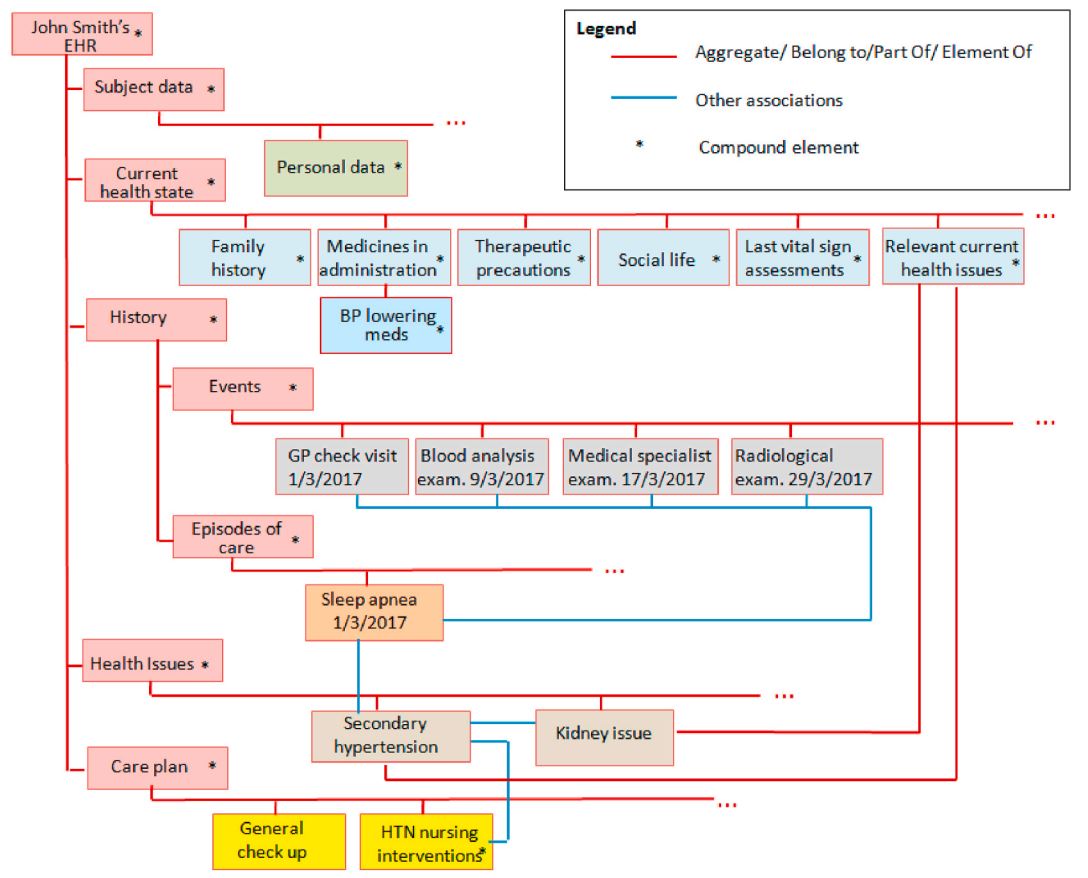
A technical element I considered indispensable was the use of semantic relations between concepts. In Fig. 5 I illustrated that instances of medical concepts do not live in isolation: they are linked by relations like "part-of", "associated with", "derived from", "contradicts", "supports", "evolves to" etc. Even if in practice we cannot fully formalize medicine, a minimum of semantic relations is necessary for contextual selection and verification. In a VHR, these relations become infrastructure for navigation, for controlled aggregations and for ambiguity reduction.
I also discussed that processing DIHSs and constructing HDS involve standard operations: selection (what is relevant for the current goal), deduplication (the same fact in multiple sources), conflict detection (e.g., incompatible information about the same problem), and chronological organization (to distinguish "history" from "current state"). These operations are, fundamentally, the "invisible work" the clinician manually performs when navigating a documentary record. In the article I tried to show that this work can be supported by IT, if we have a sufficiently disciplined model.
After 2020: In the following years, the discussion about clinical summaries, "problem lists" as the core of continuity, reconciliation, and explainability became more present. At the same time, the emergence of systems that consume large volumes of data (and sometimes propose interpretations) made the need more visible to keep a validated synthesis layer (what I called DIHS) and an integrated state layer (HDS/CHDS), which are auditable and updatable. A single terminology did not impose itself, but the general direction — moving from documents to digital representations of "health state" — seems confirmed in practice.
5. Use case, domain modeling and the mechanisms that link "state" to practice
After defining the concepts (IHS, DIHS, HDS), I felt the need to "anchor" them in practice: not just as definitions, but as elements that naturally appear in an encounter and that can be IT-supported. That's why, in this section, I combined three things: (1) a complete use case scenario (Smart EHR-assisted encounter), (2) a translation into software interaction terms, and (3) a domain model rich enough to make these interactions coherent.
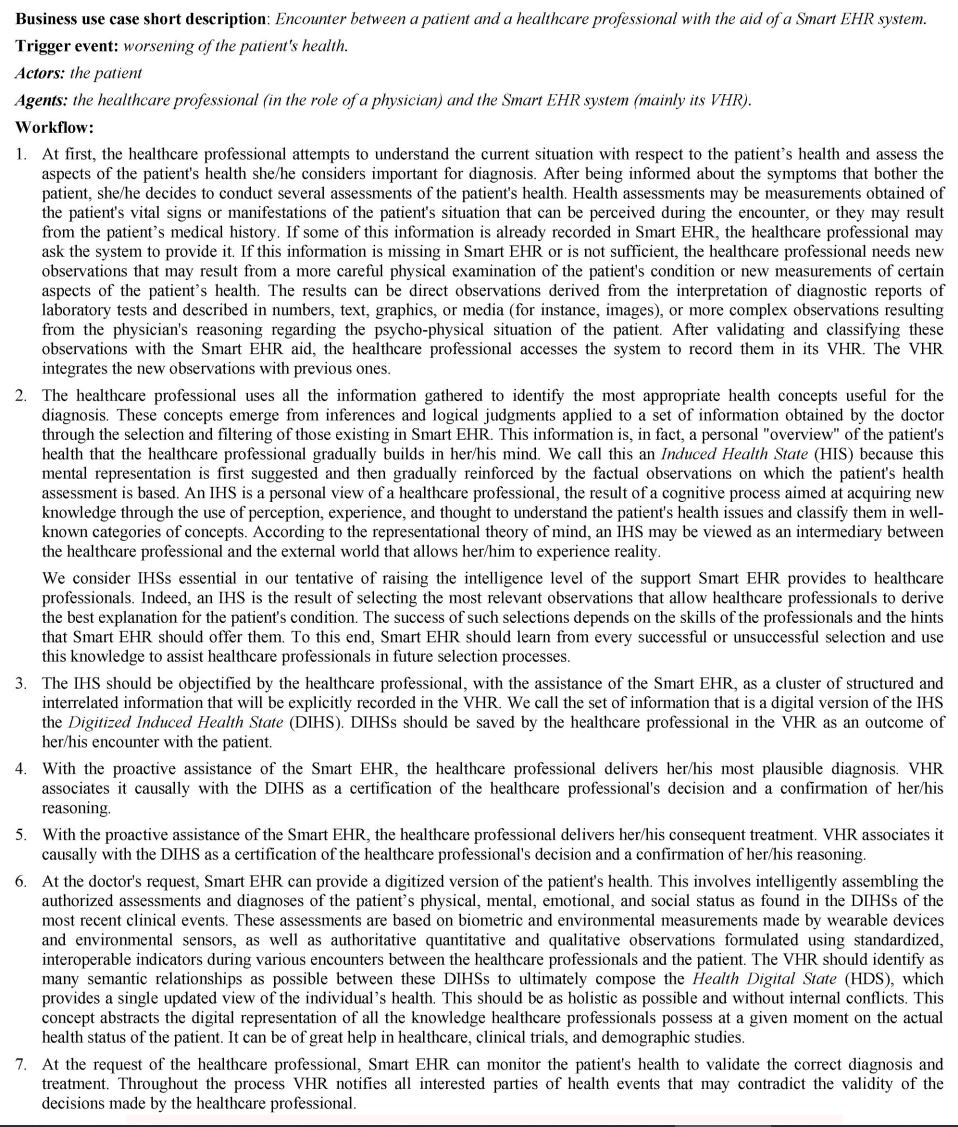
In Fig. 1 I presented the clinical encounter in a narrative format (business use case), to make the real sequence of steps visible: collecting observations, retrieving relevant history, forming a synthesis, confirming/adjusting hypotheses, choosing a plan, and subsequent monitoring. I introduced the Smart EHR/VHR's role here as an active "participant": it doesn't decide instead of the doctor, but reduces the search and context reconstruction work, flags conflicts, proposes guidelines, and keeps reusable summaries.
In Fig. 7 I transposed the same scenario into a form closer to software design (software use case), to show that narrative steps can be associated with concrete services and operations: encounter initiation, access to data and documents, observation validation, DIHS generation/update, access to guidelines and policies, building a personalized plan, and triggering event-related notifications. I aimed to make it clear that the "intelligence" I invoke is not a monolith, but the result of orchestration between integration, context, and knowledge services.
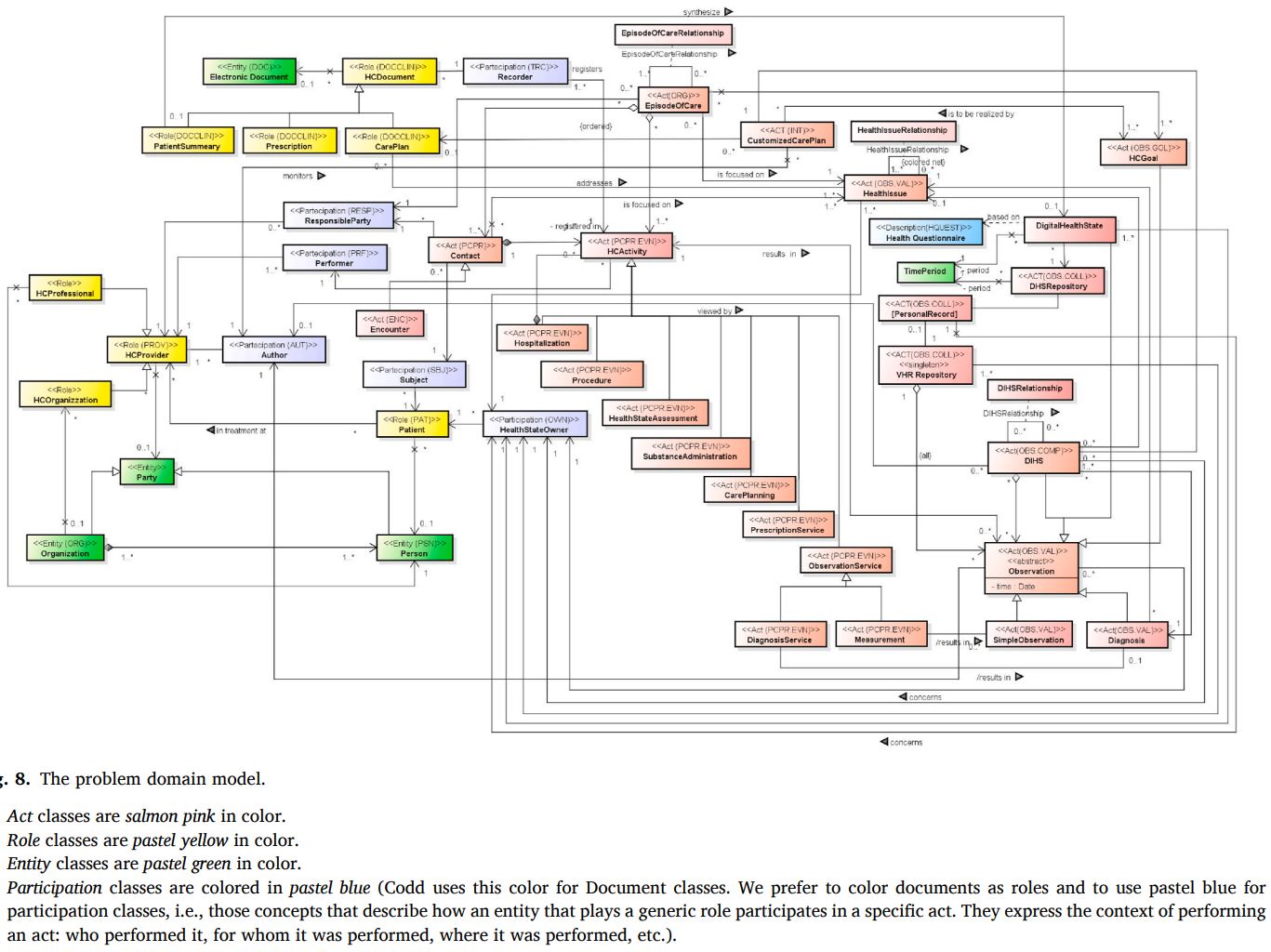
An important part of the section is domain modeling, because without a coherent model the risk is reducing medicine to a set of fields, and then discovering we cannot express what really happens. In Fig. 8 I proposed a problem domain model based on HL7 and UML standards, organized around entity types I consider essential:
- acts (encounter, observation, diagnosis, intervention, plan),
- roles (patient, medical professional, organization),
- entities (persons, organizations, resources), and
- participations (who participates in what act and in what capacity).
I also introduced a pragmatic mechanism for organizing observations: mapping them to a concept vocabulary (thesaurus / questionnaires), so the state (HDS/CHDS) can be built and updated in a controlled manner. Where an observation cannot be mapped, I preferred it to be isolated ("quarantine") for later analysis, instead of being lost or forced into an inappropriate concept. I considered this detail important because, in practice, real data is always richer than initial schemas.
From a decision support perspective, this ensemble (scenario + services + domain model) has a clear purpose: to enable the transition from dispersed information to validated synthesis (DIHS) and then to integrated state (HDS), without breaking the link to the clinical episode and professional responsibility. In other words, I tried to avoid two extremes: a passive EHR that doesn't help, and a "system that decides", which would be hard to accept clinically.
After 2020: In practice, the need for traceability between "what I observed", "what I decided" and "why" has grown. At the same time, integrating personal and remote data made it harder to maintain coherence without a domain model and semantic mapping mechanisms. In this context, the idea of a validatable synthesis (DIHS) and an updatable current state (CHDS) became easier to justify: the clinician needs to see a coherent state, but also needs to track what led to it.
6. VHR design and HDS generation: from virtualization to algorithm
In this section I tried to move from model to mechanism: how the VHR can be designed so that it supports "state" type representations (DIHS/HDS) and how a coherent digital state can be repeatedly generated from a stream of observations and documents. I insisted here on two ideas: (1) the correct virtualization of entities and events, meaning fixing the context, and (2) an explicit HDS generation algorithm, which makes visible where selection, deduplication, and conflict handling occur.
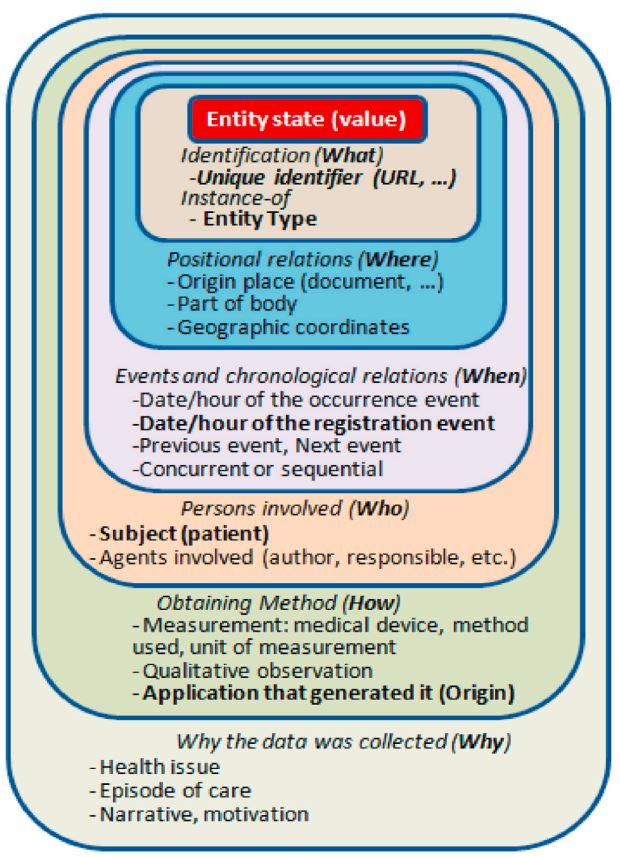
In Fig. 6 I illustrated the virtualization of a real-world entity in a VHR implementation. I used a simple set of questions (What, Where, When, Who, How, Why) to emphasize that any medical observation becomes usable only if we fix its context: what is observed, where and when it takes place, who is the actor (or who validates), by what method or device it is obtained, and for what clinical purpose (screening, diagnosis, monitoring, follow-up). In the absence of these dimensions, the same value can become ambiguous or even misleading.
I saw this virtualization scheme as a minimum threshold for "real" interoperability: not just exchanging files or codes, but exchanging facts that remain interpretable in another context. Furthermore, this metadata discipline is the premise for any support: a system can compare, deduplicate, or flag conflicts only if it knows what it compares and under what conditions the data was produced.
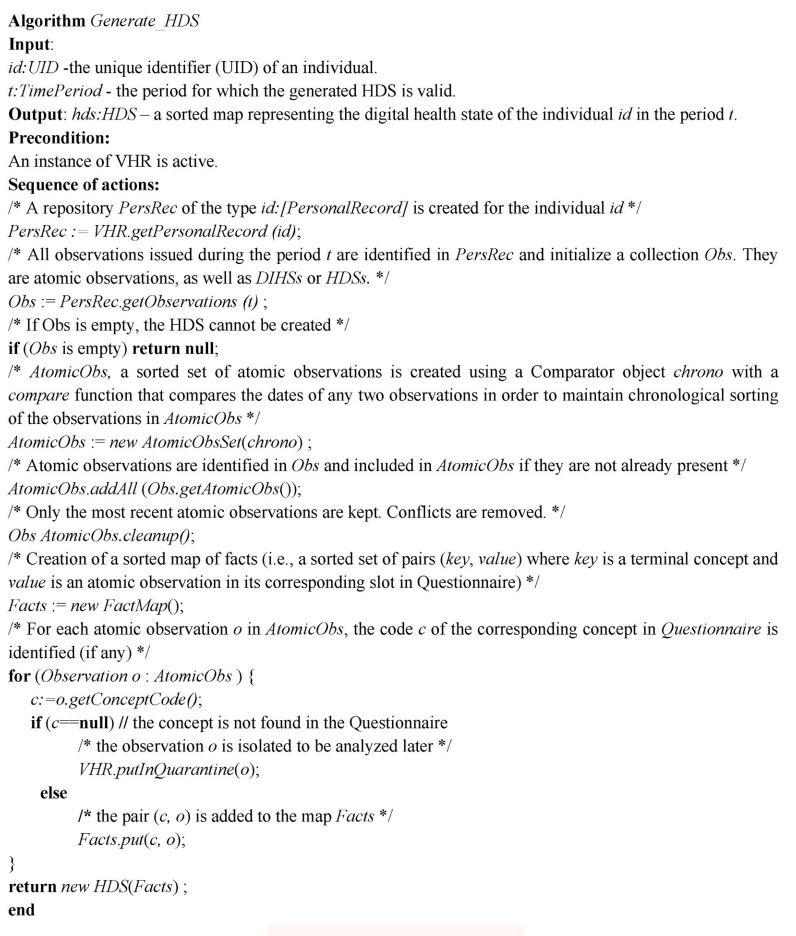
The second part of the section is the HDS generation algorithm, presented in Fig. 9. I aimed to show a clear process, even if inevitably incomplete (because medicine is only partially formalizable). In essence, the algorithm builds the HDS as a mapping between concepts and atomic observations, prioritizing the most recent and relevant ones. The steps I considered indispensable are:
- Collection of observations and relevant information for the individual and for the targeted interval/episode.
- Atomization of information: extracting elementary observations (facts) that can be associated with concepts.
- Temporal ordering and selection of "current" observations for each concept (to build CHDS).
- Conflict detection and handling (incompatible or hard-to-reconcile information), through cleaning or explicit signaling.
- Semantic mapping of observations to a vocabulary (thesaurus/questionnaires), to obtain a stable structure of the state.
- Isolation of unmappable observations ("quarantine"), for later analysis and possible vocabulary expansion.
I chose this formulation because it makes visible the "invisible work" the clinician does when manually reconstructing the patient's health state: selecting what is current, eliminating redundancies, observing contradictions, and deciding what goes into the synthesis. The algorithm does not replace these judgments, but provides a framework in which they can be supported, repeated, and audited.
A detail I considered important is the role of the vocabulary (thesaurus/questionnaires) as the structure of the state. Without a concept structure, the state risks becoming an accidental summary, dependent on document order. With a concept structure, the state becomes comparable over time and between systems, even if the data sources differ.
After 2020: In the following years, the difficulty of obtaining a coherent "current state" from distributed data became more visible, especially when data comes from continuous monitoring or multiple organizations. At the same time, the emphasis on auditability grew: it's not enough to produce a synthesis; I must be able to track what went into it and why, and explicitly signal conflicts. In this sense, metadata discipline (virtualization) and making the state building steps explicit (the HDS algorithm) became easier to motivate practically than they seemed in 2020.
7. Conclusions: what I wanted to remain and what seems confirmed to me
In the conclusions I tried to establish, without emphasis, the ideas I consider essential in this endeavor. First, I argued that the electronic record, in its predominantly documentary form, remains necessary, but is not sufficient for decision support and continuity of care when the volume and variety of data grow. If we want the EHR to become truly useful in the clinical act, we must be able to build "state" representations that are coherent, updatable, and auditable.
That's why I proposed the IHS → DIHS → HDS triad as an operational framework. IHS explicitly recognizes that clinical synthesis already exists as a cognitive process; DIHS tries to objectify it in the system, as a validated synthesis; and HDS tries to integrate, over time, observations and syntheses into a computationally usable digital state (including as a current state, CHDS). I didn't aim to "automate medicine", but to offer a way to reduce information fragmentation and support the synthesis process the clinician performs anyway.
Secondly, I insisted that practical "intelligence" begins with apparently modest, but decisive things: context, metadata, semantic coherence, deduplication, and conflict signaling. Without these conditions, any sophisticated algorithm works on an unstable basis. For this reason, I described Smart EHR as a distributed infrastructure, and VHR as an active core: a workspace that can organize information by concepts, episodes, and plans, and can support the generation of a digital state.
Thirdly, I considered it important to leave a mark of "implementability": I outlined an HDS generation algorithm, precisely to show that the "state" idea is not just a metaphor. Even if the concrete details depend on vocabulary, contexts, and rules, the basic steps (atomization, temporal selection, semantic mapping, conflict and unmappable observations handling) can be made explicit and evaluated.
After 2020: In the following years, I saw the pressure for a "current state" and reusable summaries grow, amidst the integration of data from increasingly distributed sources. At the same time, concern for traceability, auditability, and explainability grew: not just producing a recommendation or summary, but being able to show what data contributed, what conflicts existed, and what was clinically validated. In this context, the IHS–DIHS–HDS framework and the role of an active core (VHR) still seem to me a realistic direction for EHR evolution.
For me, the article remains primarily an attempt to name and make operable something that practice demands: a coherent way to move from dispersed data and documents to a "state" that can be used in decision-making, monitoring, and continuity of care, without losing professional responsibility and judgment.