


Toward a Concern-Oriented Analysis Method for Enterprise Information Systems (2006)
An approach to enterprise information systems analysis grounded in concerns — the interests, responsibilities and problems of stakeholders involved in an organization’s operations and transformation.
Navigation
Bibliographic information
Authors: Crenguța Bogdan, Luca Dan Șerbănați
Year: 2006
Document: Scientific paper, six pages
Publication venue: To be confirmed from the original bibliographic reference
Keywords: concern-oriented analysis, stakeholders, enterprise information systems, requirements engineering, separation of concerns
Provisional reference: Bogdan, C.; Șerbănați, L. D. (2006), “Toward a Concern-Oriented Analysis Method for Enterprise Information Systems”. The conference or journal details require verification.
Original illustrations (click to enlarge)


Scientific contribution
The paper proposes a method for analysing enterprise information systems through stakeholder concerns, together with a multidimensional classification of those concerns. The key idea is that the problems to be addressed by the future information system must be discovered and understood within the organizational context, rather than solely from the perspective of the software to be built.
Details (click to expand)
- A high-level specification for each concern: problem, initial state, final state and roles involved.
- Four perspectives: social, informational, functional and technological.
- Four proposed method activities: identification, classification, relationships and prioritization.
- An illustrative application to public administration services issuing tax certificates.
Detailed description (section by section)
1. Context and motivation
The paper addresses the challenge of managing the complexity of information systems. Instead of looking for requirements only in application functions, the authors begin with the organization in which the system will operate. The interests, obligations and difficulties of organizational stakeholders are sources of problems that need analysis before the system is designed.
This work is relevant to the development of separation of concerns research because it transfers concern separation from software organization to analysis of information systems and their organizational setting. The paper explicitly discusses the software-engineering literature as its starting point, without claiming to have invented the separation-of-concerns principle.
2. The information system in the enterprise context
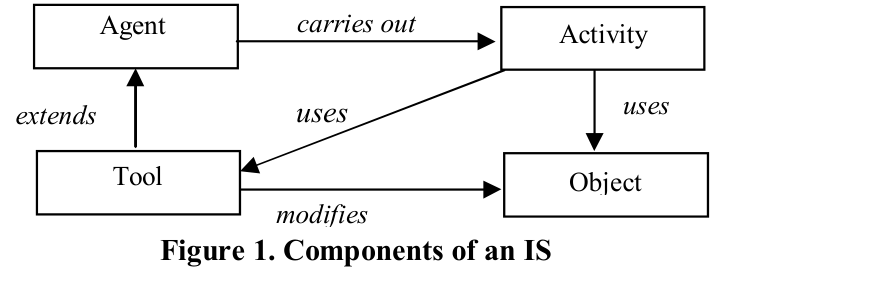
An information system is analysed as an informational representation of part of the real world. The authors distinguish four types of components: agents, activities, tools and objects. Their relationships are summarized in Fig. 1. Agents perform activities using tools and objects; this model connects the organization of work to the future information-system functions.
3. The notion of a concern
A concern is defined in terms of one or more stakeholders’ interest in or preoccupation with a concrete problem. The problem is described by an initial state and a desired final state, interpreted in the paper as the hypothesis and conclusion of a specification. By associating the interested stakeholders with it, a high-level specification suitable for requirements discussions is obtained.
The example of introducing new technology illustrates how the same information-system project can generate concerns about employee training, changes to work activities and the responsibilities of system designers. A concern, therefore, is not merely a software function or a technical requirement.
4. The analysis method
The method proposes four activities: identifying concerns, classifying them, identifying their relationships and assigning priorities. The authors clarify, however, that the paper concentrates on the first two, in the context of requirements elicitation. Relationships and prioritization are presented as elements of the overall method, rather than fully demonstrated procedures in this paper.
5. The four complementary perspectives
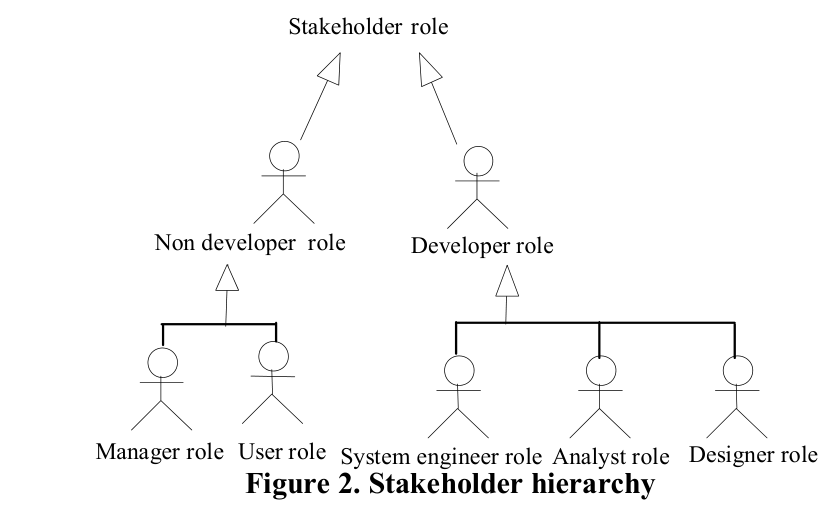
The social perspective identifies the interests, responsibilities and objectives of those affected by the system. The role hierarchy shown in Fig. 2 distinguishes developers’ roles from those of other participants.
The informational perspective addresses access to data, information and knowledge, including integrity, accuracy, completeness, security and confidentiality.
The functional perspective concerns organizational activities, their automation and the changes that the new system brings to employees’ work practices.
The technological perspective concerns ICT infrastructure and the means by which the system supports communication, information exchange and activity execution. The four perspectives are not successive phases but complementary views of the same enterprise.
6. Case study: tax certificates
An administrative office responsible for tax certificates in Romanian public administration serves as an illustration. The process includes receiving documents and preparing and issuing certificates. Taxpayers, civil servants, tax authorities and other participating institutions are identified. The authors list concerns from all four perspectives: reducing response time, ascertaining tax status, preserving data and communicating between institutions.
The example is demonstrative, not an experimental evaluation with quantitative outcomes. Owing to space constraints, the paper lists some concerns without providing complete specifications for all of them.
7. Research context and limitations
The authors discuss separation of concerns in relation to requirements engineering, multidimensional design and aspect-oriented programming. The claimed contribution is applying a concern-oriented perspective to enterprise information systems analysis. They identify comprehensibility and model extensibility as potential benefits; for other qualities — maintainability, reuse, adaptability and traceability — they mainly state expectations rather than empirical measurements.
The references also include “Understanding Concerns with Ontologies”, described at the time as submitted for publication. This provides a point of reference for the subsequent development of the research, without conflating the two contributions.
8. Conclusions
The paper proposes a way of structuring information-system analysis around the problems and concerns of organizational stakeholders. Its social, informational, functional and technological classification is intended to prevent the problem from being prematurely reduced to a single design perspective. The result is a methodological framework requiring further work on relationships between concerns, prioritization and systematic evaluation.