


Virtual Perception Based Agents in Virtual Theater (2003)
A proposal for modelling the behaviour of autonomous agents in distributed virtual environments through emission and perception fields and information links.
Navigation
Bibliographic information
Authors: Dorin-Mircea Popovici, Luca-Dan Șerbănați, Jean-Pierre Gerval
Year: 2003
Event: TIDSE 2003, Darmstadt — the exact bibliographic reference of the published version remains to be verified
Topics: distributed virtual environments, autonomous agents, virtual perception, fuzzy fields, VTagent
The available PDF is the submitted manuscript; publication details and page numbers for the final version still need confirmation.
Original illustrations (click to enlarge)


Scientific contribution
The principal contribution is a formal model of interaction between virtual entities, defining perception and communication by means of fields, rather than solely by coordinates or predefined scenarios.
Details (click to expand)
- Aura/nimbus: information emission and reception as domains of variable intensity and sensitivity.
- Information forms: producers, consumers and translators.
- Information link: signal strength weighted by the receiver’s perceptual capacity.
- VTagent: receptors, effectors, knowledge and an analysis/decision component.
Detailed description (section by section)
1. Context and objective
The article proposes a behavioural modelling approach for agents in distributed virtual environments. The theatre metaphor supplies a setting for autonomous characters that can play roles and interact, including with a user represented by an avatar. The objective is not simply to render the virtual world graphically, but to explain how entities perceive changes, make decisions and respond.
2. Information space
The virtual environment is treated as a collection of information spaces of different kinds: visual, auditory, haptic and others. Information is represented as attributes of entities, to which transformation operations may be associated. This formalization supplies the mathematical basis for emission, perception and interaction mechanisms.
3. Aura and nimbus
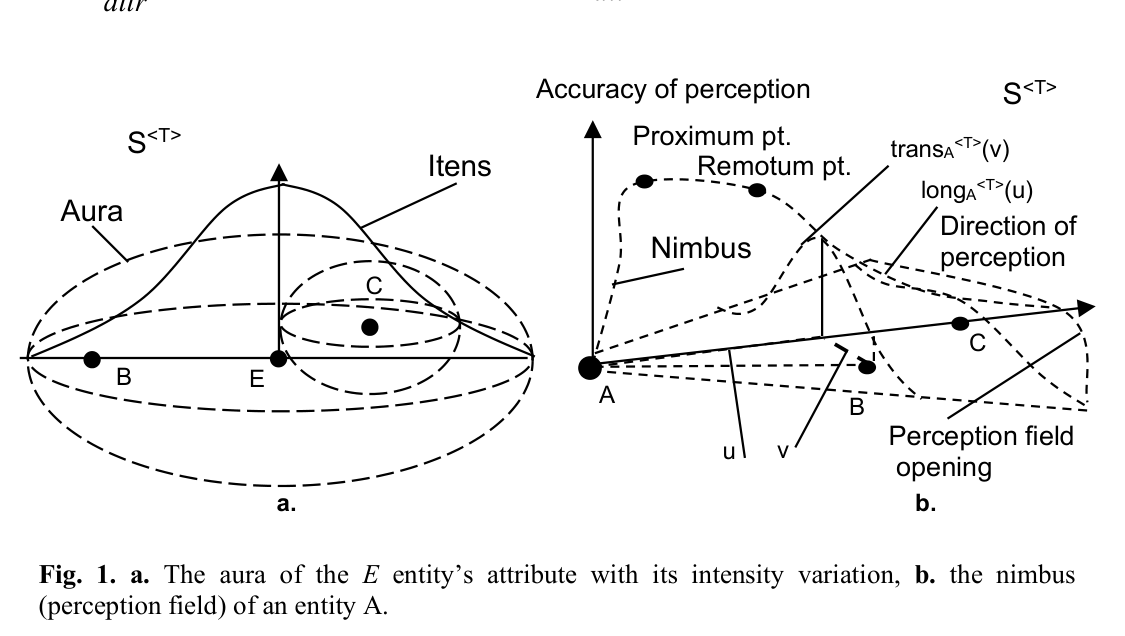
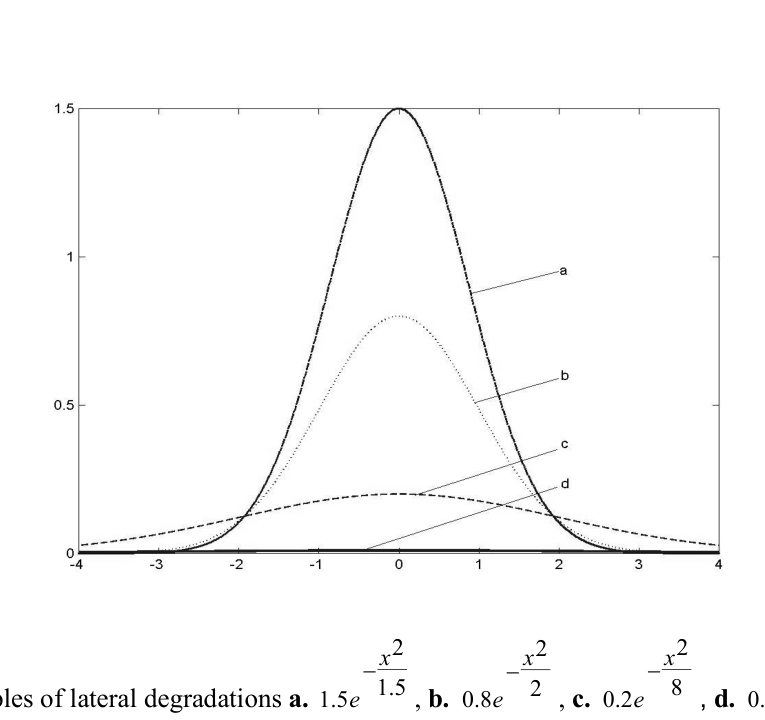
The authors distinguish aura, the domain in which an entity attribute can emit information, from nimbus, the domain in which another entity can perceive that information. Emitted signal intensity and perceptual accuracy may vary with position and direction, subject to fuzzy constraints. Fig. 1 illustrates the two fields, while Fig. 2 illustrates the lateral decline in perception accuracy.
4. Information forms and links
Attributes endowed with action and/or activation domains constitute information forms, classified as producers, consumers and translators. An information link between two forms depends on their compatibility and is expressed quantitatively as the product of the emitted signal intensity and the receptor’s degree of perception. Interaction is therefore not reduced to geometric proximity.
5. Virtual entities and agents
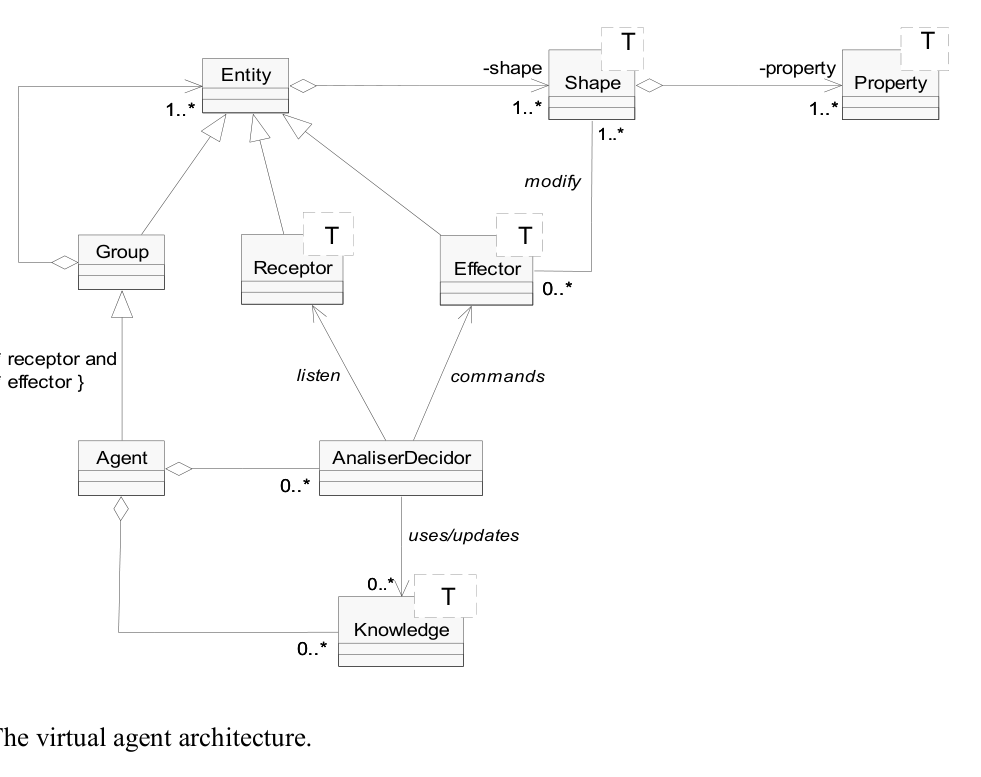
An entity consists of information forms connected by intrinsic or extrinsic links. The VTagent virtual agent adds receptors, effectors, knowledge and an analysis/decision component. Fig. 3 presents the proposed architecture. The article envisages reactive, cognitive, affective, evolutionary and hybrid organizations; it does not experimentally demonstrate all these variants.
6. From stimuli to actions
Environmental stimuli are received, filtered and transformed into inputs for the decision-making component; responses activate the effectors. The authors also describe decomposing a task into actions, operations and property changes, with temporal activation constraints. The example is the delivery of a line in a play: identifying the interlocutor, moving closer and speaking the line.
7. The VTheater application and its limitations
The theatre metaphor includes spectators, actors, an author, a director and other roles. In 2003 VTheater was described as under development: an interactive storytelling environment in which autonomous characters react to environmental changes. Virtual tours, museums, aquariums and educational environments are cited as possible specializations. The article primarily offers a conceptual and formal model, not a quantitative experimental evaluation or proof that all the listed applications were implemented.
8. Place of this research in the broader programme
The article documents a research direction concerning autonomous agents and the formal representation of interactions in virtual environments. It is relevant to broader topics of conceptual modelling and agent-based systems; however, it should not be described as a demonstrably direct precursor of later healthcare architectures without additional bibliographic evidence.
Conclusion
The article’s value lies in moving from the visual depiction of an avatar to the formal modelling of conditions under which agents can perceive, communicate and act. The theatre metaphor provides an application scenario, while the information model and VTagent architecture are the main technical contributions. Virtual tutors and guided tours are not presented as validated results of the paper.