Concern-Oriented and Ontology-Based Analysis of Information Systems
I find this article to be the synthesis and maturity text of the direction developed together with Crenguța Bogdan. If previous articles had introduced the concern-oriented method, the ontological definition of the concern, and the construction of facets, here all these threads are brought together into a single coherent framework. The information system is explicitly viewed as a composition of multi-facetted views, built on the basis of the domain ontology and the ontological UML models extracted from the mental descriptions of the stakeholders' beliefs and knowledge.
Bibliographic data
Authors:
Crenguța Bogdan, Luca Dan Șerbănați
Title:
Concern-Oriented and Ontology-Based Analysis of Information Systems
Year: 2010
Type: synthesis text / extensive article
Figures from the article
Thumbnails (click to enlarge)


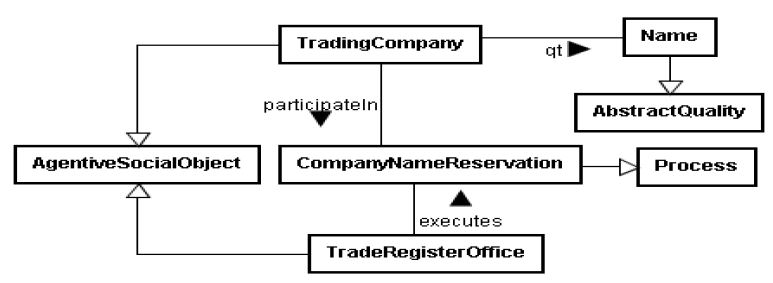
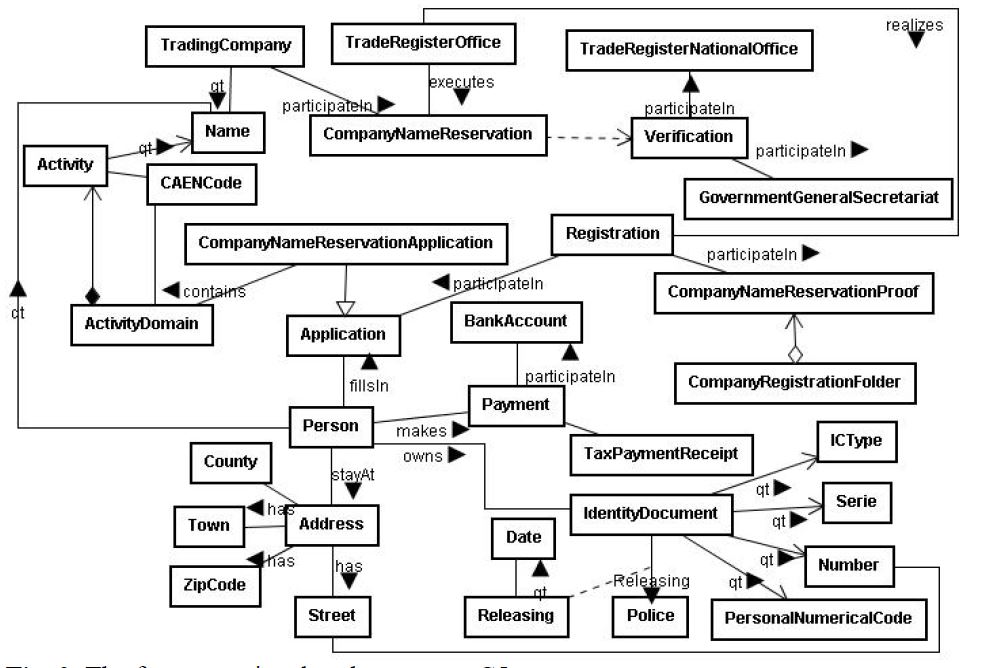
Fig. 1. The UML ontological model for the knowledge K5 from the case study.
Fig. 2. The facet associated to the concern C5.
Conceptual contribution
The article brings together in a mature form the entire concern-oriented method and formulates it explicitly as a method for building the domain model of an information system as an aggregation of multi-faceted views.
- defines the information system as a composition of multi-facetted views;
- links concerns to semantic rationales, vocabulary, and domain ontology;
- explains the role of UML ontological models as a bridge between ontology and modeling;
- shows how facets are obtained through a mechanism of abstraction applied to the ontology;
- moves the demonstration from clinical trials to a more general case study, from public administration.
Description
This text starts from a central problem in information systems development: their complexity and the difficulty of building a conceptual model rigorous enough to support the entire development. The authors clearly state that in order to manage this complexity, a systematic partitioning of the models is needed and that this is precisely where concern-oriented analysis comes in.
The article first revisits the core of the basic definitions. A concern is treated as a worry originating from a problem, manifested by one or more stakeholders involved in the construction or evolution of the system. To be able to work effectively with a concern, it must be described by a high-level specification, that is, by the association between a description of the initial state of the problem, a description of the desired final state, and the role of the stakeholder who manifests that concern.
From this point, the article very clearly formulates one of the most important ideas of the whole series: the information system is viewed as an aggregation of views created by composing facets. The facets are not just arbitrary pieces of model, but concern-driven abstractions, built based on the relevant beliefs and knowledge of the stakeholders. Here the "views and facets" theme, which already appeared in previous articles, is put at the center of the perspective.
An essential role is played by the semantic rationales of the concerns. The article states that we do not consider all beliefs and all knowledge of a stakeholder, but only those that make up the semantic motivation of the concern when the stakeholder plays their role. These semantic rationales are the source from which the vocabulary necessary to build the domain ontology is extracted.
On this basis, the text presents the extended method in 15 steps. The first 11 steps belong to the core concern-oriented method already formulated previously: identifying stakeholders, identifying concerns, classification and relationships between them, prioritization, identifying semantic rationales, extracting concepts, ontological analysis of their intension, choosing a foundational ontology, classifying concepts, and defining the domain ontology. To these are added four more steps, dedicated precisely to building views: ontological UML models, building facets, analyzing their independence, and grouping them into views.
The article then explains very well what a UML ontological model means. This is a class diagram that semi-formally describes the semantics of a piece of knowledge or a belief belonging to the semantic rationale of a concern. Thus, the domain ontology does not remain just an abstract logical structure, but is transposed into a form closer to the modeling tools currently used in systems engineering.
From here the mechanism of abstraction intervenes again. The authors show that, starting from the ontological UML models, those ontological classes and relationships that must be part of the domain model of the future system are selected. Some classes coming directly from the categories of high-level ontologies are filtered, but only when their removal does not destroy the semantics of the facet. The result is a simplified structure, but still faithful to the meaning of the concern.
The chosen case study shifts the focus from the previous applications in clinical trials. Here, the example is an information system that supports the registration of a new commercial company in the Romanian public administration. Diverse stakeholders are identified — founders, administrators, lawyers, judges, civil servants, and service providers — and 31 concerns are extracted. For concern C5, related to choosing the name of the new company, both relevant knowledge and beliefs are presented, as well as the ontological UML model for the knowledge K5 and the resulting facet.
The choice of this case study is important. It shows that the method is not limited to medical informatics, but has a more general scope for information systems analysis. At the same time, the conclusion of the article clearly shows that the authors intended to apply the method also in the field of longitudinal health care records management, which makes this text a bridge towards the subsequent concerns in digital health.
Viewed in retrospect, this is the article in which Crenguța's series reaches its most unitary form. The notions of concern, semantic rationale, domain ontology, ontological UML model, facet, and multi-faceted view no longer appear as separate themes, but as parts of a single conceptual architecture.
The article's place in the research path
I see this article as the synthesis text of Crenguța Bogdan's direction around ontologies and concern-oriented analysis. If the 2006 article is the genesis, the one on Understanding Concerns with Ontologies is the theoretical pivot, and the text on constructing facets introduces the modeling mechanism, here all these lines are brought together in a mature and coherent formulation.
At the same time, the article has a broader significance for me. It expresses very well one of the quests that has long interested me: how can the complexity of a system be ordered through a plurality of coherent views, without falling into arbitrariness and without losing the semantics of the domain.
This article belongs to my research direction regarding conceptual modeling and ontologies , developed together with Crenguța Bogdan around concerns, domain ontologies, views, and facets of information systems.
Links
- Back to Crenguța Bogdan's page
- Toward a Concern-Oriented Analysis Method for Enterprise Information Systems (2006)
- Understanding Concerns with Ontologies (2008)
- Towards an Ontology using a Concern-Oriented Approach for Information Systems Analysis (2007)
- A Concern-Oriented and Ontology-Based Approach to Constructing Facets of Information Systems (2007)