Supporting Adaptability in Agent-Based Digital Healthcare Ecosystem (2011)
This article develops the Digital Healthcare Ecosystem direction in an essential point: the transition from conceptual modeling of the ecosystem to concrete mechanisms of adaptation, evolution, and reconfiguration of digital health services. It introduces a biologically inspired approach, based on agents, virtual organisms, and habitats, through which the digital ecosystem can reflect reality, generate new solutions in the virtual environment, and then return them to the real world in the form of better-adapted e-health services.
Bibliographic Reference
Authors:
Victor Rentea, Fabrizio L. Ricci, Luca Dan Șerbănați, Andrei Vasilăteanu
Title:
Supporting Adaptability in Agent-Based Digital Healthcare Ecosystem
Published in:
COGNITIVE 2011: The Third International Conference on Advanced Cognitive Technologies and Applications
Year: 2011
Pages: 104–109
Publisher / Series: IARIA
ISBN: 978-1-61208-155-7
Article Figures
Thumbnails (click to enlarge)
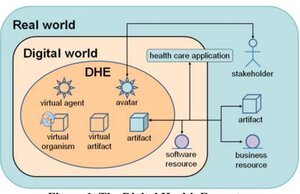
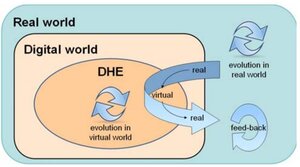
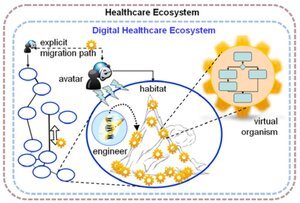
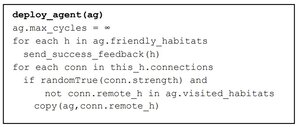
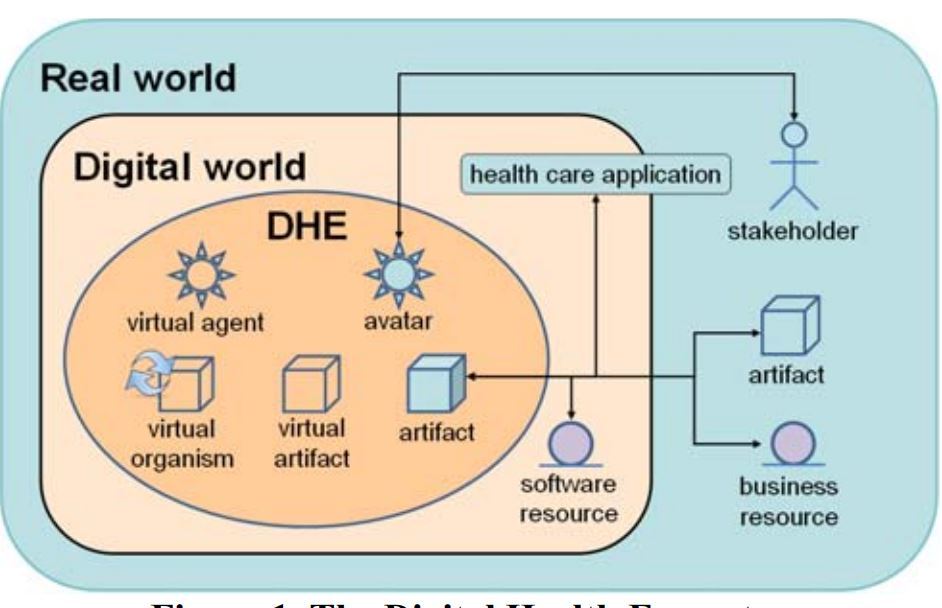
Fig. 1. The Digital Health Ecosystem: real entities projected in virtual, artifacts, agents, and their relationships.
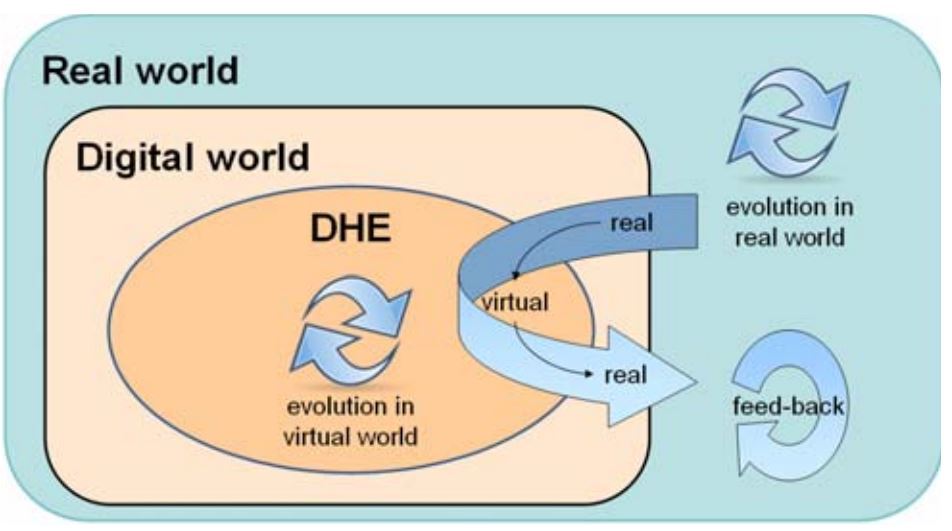
Fig. 2. "Real to Virtual to Real": the scheme of the three control loops between reality and virtual.
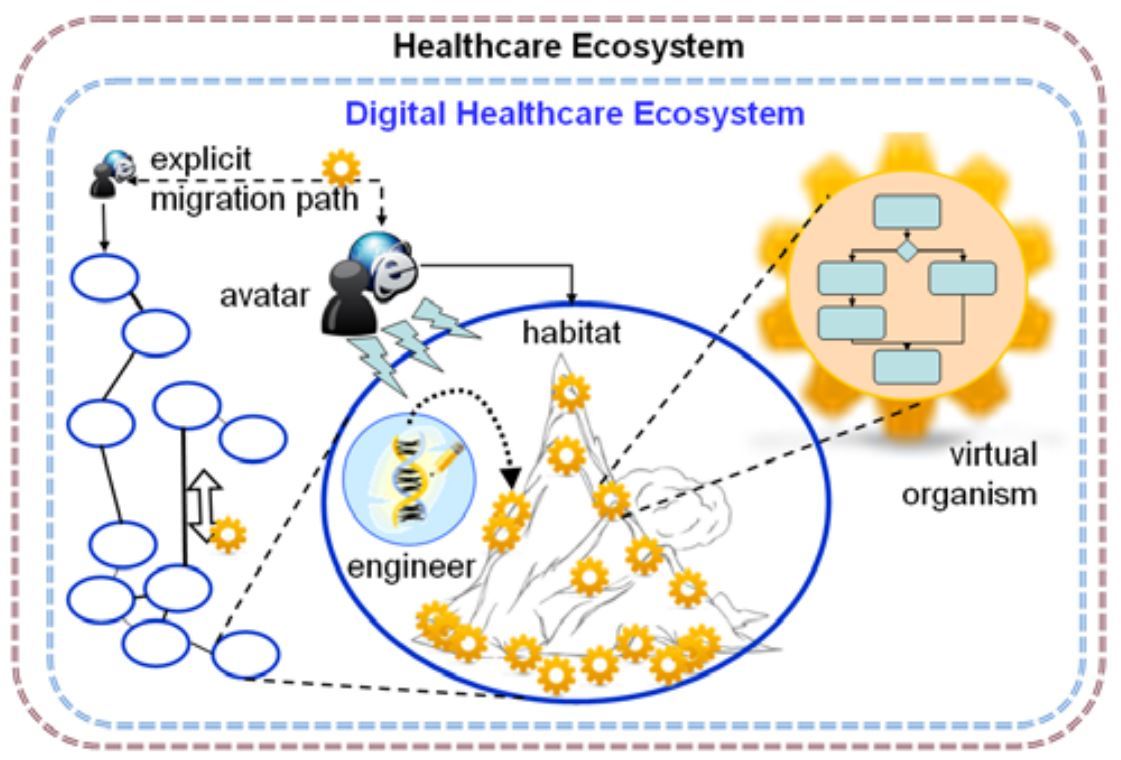
Fig. 3. Virtual Organisms in the network of Habitats: avatar, habitat, migration, fitness landscape, and internal structure of a VO.
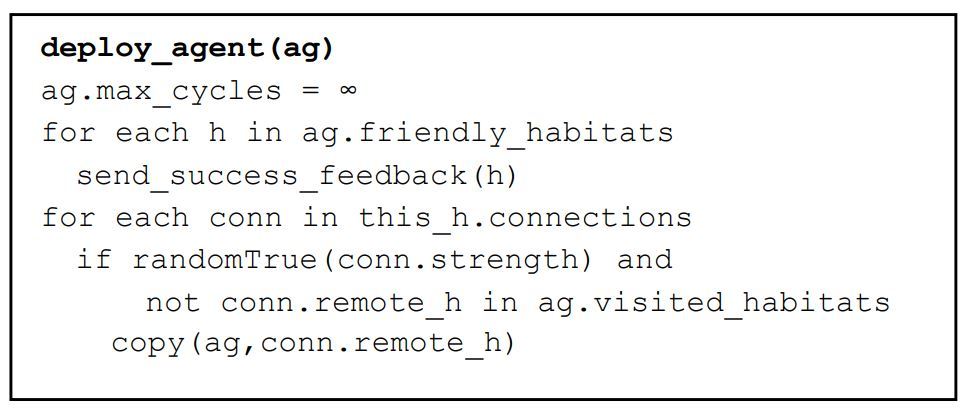
Fig. 4. The propagation algorithm of a successful agent through habitats and strengthening the connections between them.
Conceptual Contribution
The article brings to the forefront the idea that a Digital Healthcare Ecosystem is not just a static representation of the medical domain, but an environment capable of supporting continuous adaptation of digital services.
Its novelty lies in combining four lines:
- continuity of care on informational, managerial, and relational dimensions;
- the agents and digital ecosystems paradigm;
- a biomimetic conception of software services evolution;
- a model of continuous transition between the real world and the virtual world.
Compared to the more general text about the digital health ecosystem, the internal mechanism of adaptation already appears here: avatars, artifacts, virtual organisms, habitats, migration, selection, and learning through feedback.
Description
This article marks an important step in the evolution of my research on the digital health ecosystem. While in previous works the emphasis was mostly on the informational structure and the digital representation of health status, here the center of gravity shifts towards adaptability: how can such an ecosystem react to changing norms, clinical needs, and organizational configurations.
The article starts from an observation that remains valid today: classic medical informatics systems were built around acute episodes of illness and short interactions between patient and caregiver. They struggle to meet the requirements of patient-centered medicine, carried out long-term, involving multiple institutions and actors. Therefore, a paradigm shift is necessary, in which continuity of care is supported informationally, managerially, and relationally.
In this framework, the Digital Healthcare Ecosystem is conceived as a virtual world in tight connection with the real world. Reality is reflected in the virtual through observation and representation mechanisms, and the virtual can act back upon the real by proposing or implementing new solutions. This movement is explicitly described as a "real to virtual to real" process, meaning a succession of control loops between the two worlds.
An essential element is the distinction between types of entities in the ecosystem. Some are projections of real entities, others exist only in the virtual environment. In this architecture, avatars represent real actors and pursue their goals, while artifacts are passive or reactive projections of resources, applications, devices, or objects. For the patient, the central reflection in the virtual remains the Virtual Healthcare Record, meaning a representation as complete and authorized as possible of their health state, clinical history, and care processes.
However, the real originality of the article begins with the introduction of virtual organisms. These are not proactive agents in the classical sense, but virtual structures capable of evolving autonomously according to the environment in which they live. They represent software components or service compositions, semantically described and executable in an SOA manner. Each organism lives in a habitat, associated with an avatar, and habitats form a distributed network, each with its own local conditions and request history.
Here appears a very fertile idea: the ecosystem does not generate software out of nothing, but evolves solutions starting from already existing components. In other words, local human creativity, materialized in disparate services and applications, becomes the raw material for global evolution. Virtual organisms are selected, moved, copied, recombined, and evaluated according to their utility. Thus, the ecosystem can produce services more suitable to the context, more efficient, and better adapted to new requirements.
At this point, the article introduces an important distinction between genotype and phenotype. The genotype of a virtual organism is the encoding of the service flow it contains; the phenotype is its actual behavior in the execution environment: response time, availability, cost, quality, security. This distinction is essential because the same software composition can function differently in different environments. Hence the need for a finer selection mechanism, capable of taking into account not only structure, but also contextual behavior.
Unlike other digital ecosystem models, a single genetic algorithm is not imposed here. The article explicitly admits a plurality of evolutionary mechanisms and introduces the idea of engineer agents, agents specialized in generating applications based on the local population in the habitat. This openness is important: the article does not lock the architecture into a single procedure, but leaves room for variety and diversification of evolutionary strategies.
Another remarkable point is the migration of virtual organisms between habitats. Strong organisms can be copied to quickly spread good solutions; weaker ones can be moved, because in another context they might become useful. This avoids getting stuck in a local optimum and maintains the ecosystem's diversity. The success of the migration strengthens the links between habitats, in a manner inspired by Hebbian learning: useful links are consolidated, useless ones are weakened. A fixed network thus becomes a network that learns from its own experience.
The article also insists that the finality of the digital ecosystem is not internal, but oriented towards reality. Solutions evolved in the virtual become useful only when they can modify the real world in the form of new or adapted services. One discussed example is the automatic adaptation of applications to legislative or normative changes. A rule modification can be "pushed" into the digital ecosystem, where avatars sense the impact on existing applications and launch adaptation processes. Within reasonable limits, reality can thus be protected from the complexity of continuous change.
From this point of view, the article is one of the works in which the concept of Digital Healthcare Ecosystem gains true internal dynamics. It is no longer just about an integration infrastructure or a conceptual scheme, but about a transformation mechanism capable of supporting the evolution of medical software in a distributed, heterogeneous, and changing environment.
Place in the Research Journey
In the sequence of my works in the digital health area, this text occupies a linking position between ecosystem modeling and the idea of agentification. It extends the direction opened by the Virtual Healthcare Record and the introductory works on the Digital Healthcare Ecosystem, but goes further than them, because it attempts to explain how one can effectively obtain the adaptability of such a system.
At the same time, the article clearly opens a path that will later lead to avatars, digital twins, and richer forms of distributed intelligence in healthcare. The idea of representing the real world in the virtual, followed by a return of the virtual into the real through influence and reconfiguration, anticipates one of the major axes of my subsequent research.
Viewed retrospectively, this is one of the texts in which the digital health ecosystem ceases to be just a conceptual framework and begins to become an evolutionary environment. That is why it deserves to be explicitly placed in the DHE branch and, at the same time, used as a crossing point towards the later stages, closer to agents, avatars, and digital twins.
Links