Agent-Based Modeling of Virtual Environments
Dorin-Mircea Popovici, Luca-Dan Șerbănați, Jean-Pierre Gerval — 2003
Bibliographic data
Authors: Dorin-Mircea Popovici, Luca-Dan Șerbănați, Jean-Pierre Gerval
Title: Agent-Based Modeling of Virtual Environments
Published in: VRIC 2003
Field: virtual reality, virtual agents, informational modeling
PDF: Download the article
Main themes
- the informational space of the virtual environment
- the aura and nimbus of entities
- informational forms and links
- virtual entities and agents
- decision-making mechanism based on fuzzy cognitive maps
- application within the VTheater metaphor
Figures from the article
Thumbnails (click to enlarge)
>Conceptual contribution
For me, the interest of this article lies in the fact that it formulates quite clearly the informational model of the virtual environment that I was working on together with Mircea Dorin Popovici. The article does not stop at 3D graphics or character animation, but proposes a modeling framework in which the environment is viewed as a multidimensional space populated by entities that emit, perceive, and exchange information.
The notions of aura and nimbus, together with the idea of an informational link, represent the original core of the proposal. They allow the transition from isolated objects to a virtual universe seen as a system of interactions. From this perspective, the article well marks the transition from the metaphor of the virtual theater to a more general model of the virtual space.
The text was also important for Mircea's thesis, as many of the ideas presented here would be resumed and later developed in the central chapter of his doctoral work.
Summary and context
The article starts from the idea that the central element of any virtual environment is the user, specifically the avatar through which they express themselves in a given context. In this framework, modeling a virtual environment means identifying the actions allowed to the user and the way the environment's components respond to them, making the experience credible.
The text follows the concerns for VTheater, but tries to go beyond the simple theatrical metaphor and propose a more general model. The virtual environment is treated as a multidimensional universe populated by interacting entities, and its dynamics are given by the flow of information between these entities.
The proposed model
The first important contribution of the article is the introduction of the notion of informational space. Each type of information — visual, audio, haptic, or otherwise — is treated in its own space, with elements, generators, and transformations. This construction allows the virtual environment to be described in a more general way than by the simple geometry of objects.
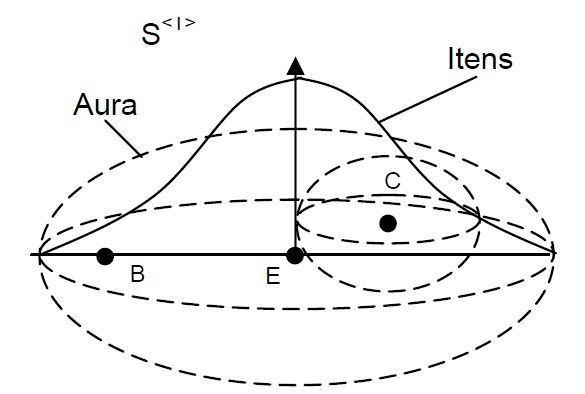
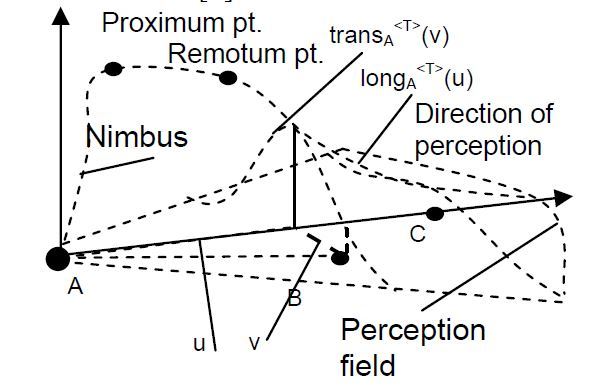
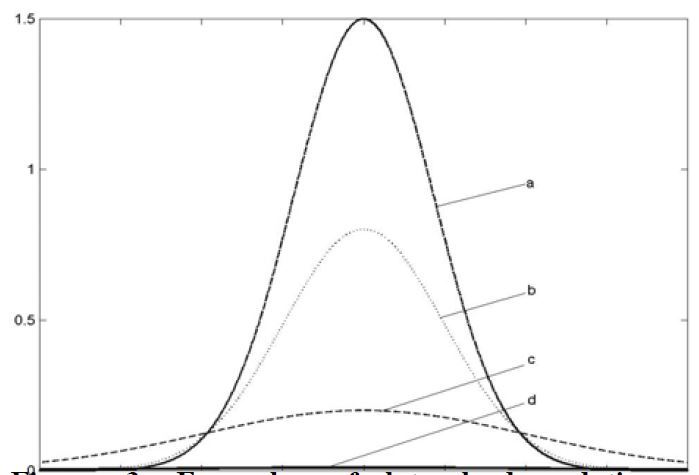
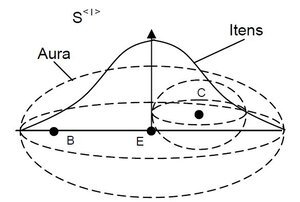
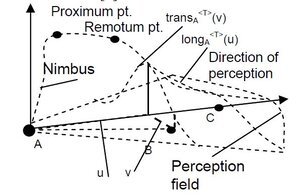
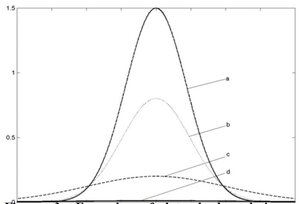
On this basis, two essential notions are defined: the aura and the nimbus. The aura is the emission field of an entity, i.e., the subspace in which one of its attributes can be perceived by other entities. The nimbus is the perception field, i.e., the domain in which an entity can detect the information emitted by others. The article proposes a fuzzy modeling for these fields, inspired by human perception mechanisms.
From attributes equipped with aura and nimbus, informational forms are built: producing, consuming, and translating forms. Between them, informational links are established, through which communication and influence between entities are expressed. The virtual environment thus becomes an organization of informational forms in dynamic connections.
Virtual agent architecture
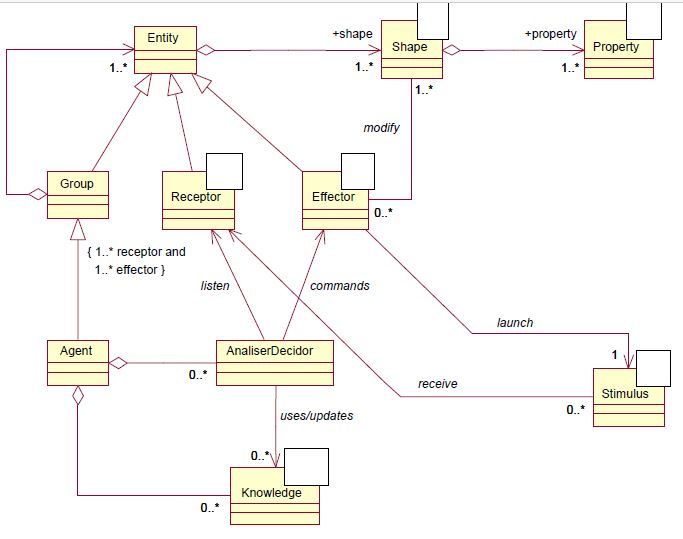
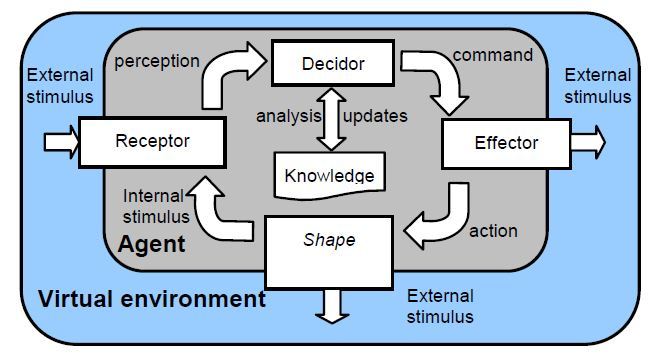
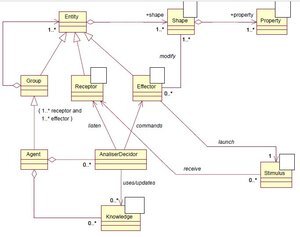
The second major contribution of the article is defining the virtual entity and the virtual agent. The virtual entity is understood as a set of informational forms that complete its meaning. The virtual agent emerges when these entities are aggregated together with receptors, effectors, knowledge, and an analyzer-decision-maker component.
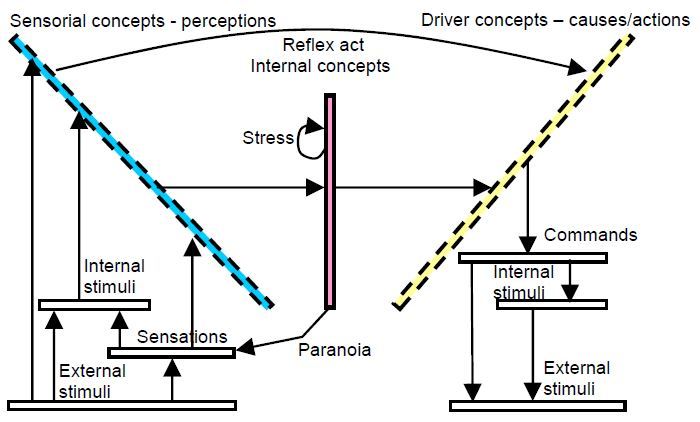
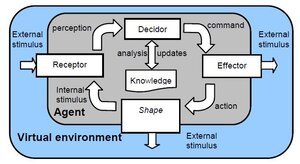
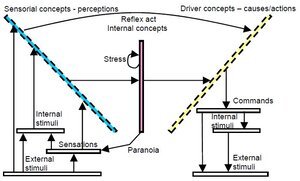
The proposed structure for the agent is a rich one: forms, knowledge, receptors, effectors, and a decision module. Stimuli, internal or external, are translated into perceptions; perceptions activate the decision; and the decision commands the effectors. In this way, the agent can perceive, decide, and react in its environment.
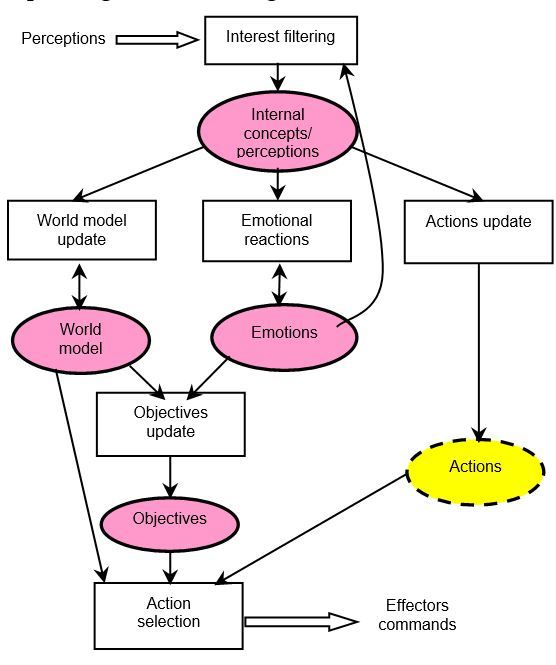
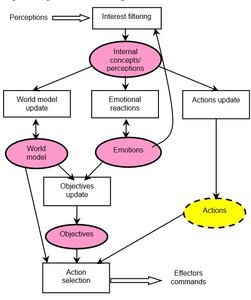
The decision component is built around a fuzzy cognitive map. The article describes the filtering of interest, updating the world model, emotional reaction, updating objectives, and action selection. This results in an architecture that attempts to link perception, knowledge, and behavior within a unitary framework.
Connection to VTheater
The last part of the article shows that the model is not conceived in the abstract, but is experimented within the VTheater metaphor. In this interpretation, the virtual theater is an environment populated by autonomous characters, each endowed with objectives, a profile, and capabilities. The lines, reactions, and interactions between the characters are seen as manifestations of the virtual agent in its environment.
The interest of this application, however, is broader. The article explicitly states that the model can be extended to virtual tours, historical sites, urban environments, zoos, aquariums, or educational environments. For this reason, it is one of the texts in which the initial theater metaphor begins to transform into a more general theory of the virtual universe.
Figures from the article